

97%+
750K+
150K+
260M+
120+
How it works
Three steps, and none of them are yours.
No integration per hospital. No release-of-information forms. No waiting on a fax.
You search for a patient
Send the demographics you already have — name, date of birth, address — through our API or type them into the chart.
API or viewerWe search the whole country
All five national networks at once — TEFCA, Carequality, CommonWell, eHealth Exchange and California's exchange — plus the laboratories directly. And if we learn your patient lived somewhere else, we search there too.
All five networks, in parallelYou get one record
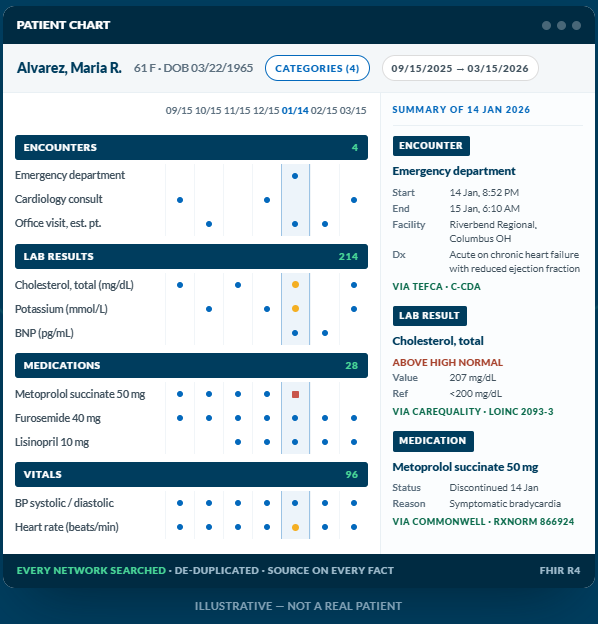
Duplicates collapsed, codes reconciled, the right person confirmed, every fact traceable to the network and facility it came from. It arrives as FHIR — the standard format health software reads — or as the chart itself.
FHIR R4, or the chartBuilt for
EHRs
health plans
digital health
value-based care
labs
patient access apps
How it works
MEDITECH
CenterWell
Monogram Health
FUNCTION HEALTH
virta
DNAvisit
One patient, one year
Nobody in this story ever thinks about
interoperability.
Maria is 61, has heart failure, and lives in Ohio. Over one year, six of our clients each do their job better because her record was already whole when they needed it. Each moment below belongs to one of the buyers further down the page.
Late winter
A new cardiology
practice takes her on
Her referral arrives with eleven years behind it, not a one-page summary and a request for records.
How it works
Spring
Her plan opens a case
The care manager works from clinical history instead of inferring it from claims that are six weeks old.
Payers · Patient360
Spring
Labs before the next visit
Ordered inside the app she already uses, returned as structured results filed against the right patient.
Labs · Lab Network
Summer
She shares her record with her daughter
Maria uses a patient access app to request her own records and pass them to her daughter, who helps manage her care from another state. She verifies who she is once, and the history follows.
Individual Access Services · Patient360
Summer
An overnight stay for fluid overload
Her care team hears about it from the network, not from a claim three weeks later — and the hospital's data flows back out.
Value-based care · Clinical Alerts
Autumn
The call three days after discharge
Whoever picks up the phone already knows what happened, what changed, and what to watch for.
Digital health · Clinical Alerts
Maria and her care team focus on her care, not on a scavenger hunt for the records that explain it.
That's the job. Not a dashboard anyone logs into, but a record that arrives complete and in context at each of the moments where being incomplete would have cost her something. There is a patient at the end of the data, and this is what it looks like when the data is ready for her.
No blind spots
A blind spot doesn't look like an error. It looks like a finished record.
When a hospital sends a record to a clinic, it travels over one of five national networks — shared exchanges that connect health systems to each other. Reach four of them and nothing fails: no alert fires, no field goes red. The chart just comes back thinner, and the decision gets made anyway, on a version of the patient that isn't real.
The urgent care visit two states over — on a network your vendor doesn't reach.
The specialist your patient saw before they moved — filed under an address nobody searched.
The diagnosis coded SNOMED in one chart and ICD-10 in another — counted twice, or missed by the filter entirely.
Two people quietly merged into one patient — because matching was tuned for volume instead of accuracy.
All five. Every search.
All five. Every search.
You can't audit a record for what isn't in it.
Coverage isn't a procurement checkbox — it's the ceiling on everything downstream. A quality measure, a risk score or a care decision is only as good as the records that reached the chart, and completeness is the one dimension you can't fix later.